webtrail Brian · My field notebook for trails and the web
A narrow dirt path winds through brown heather moorland and disappears into thick fog, with only a few rocks visible beside it.
5 stops

Can an AI Decide Anything? Agency and the Words We Use

27 September 2026 · charted with AI, reviewed by hand

Your coding assistant "decided" to rewrite a function you never asked it to touch. Your chatbot "wants" to please you. You told the agent to stop, and it "ignored" you. Most of us talk about AI tools this way without a second thought, and the words do real work: they shape what we expect, who we blame when something goes wrong, and whether we suspect anyone is home.

So can an AI decide anything, or is "decide" shorthand for a very large calculation? Following this series' first post on whether it is all just math, this one turns from what these systems are to the vocabulary we use for them. It matters to anyone who works with these tools daily.

The sources below form a running argument, some replying to one another directly. They start from a strictly technical view that refuses human vocabulary altogether, move through a defence of using it and a pragmatic middle ground from philosophy of mind, pause on what the word "thinking" even means, and end with a philosopher's case that the habit misleads us. Read them in order and see where you land.

This post references third-party websites for informational purposes only. webtrail does not host, own, or claim any rights over the content of the linked sites. All screenshots are used for illustrative purposes and link back to their original source.

The stops

5 sites, each opened and read
01
addxorrol.blogspot.com
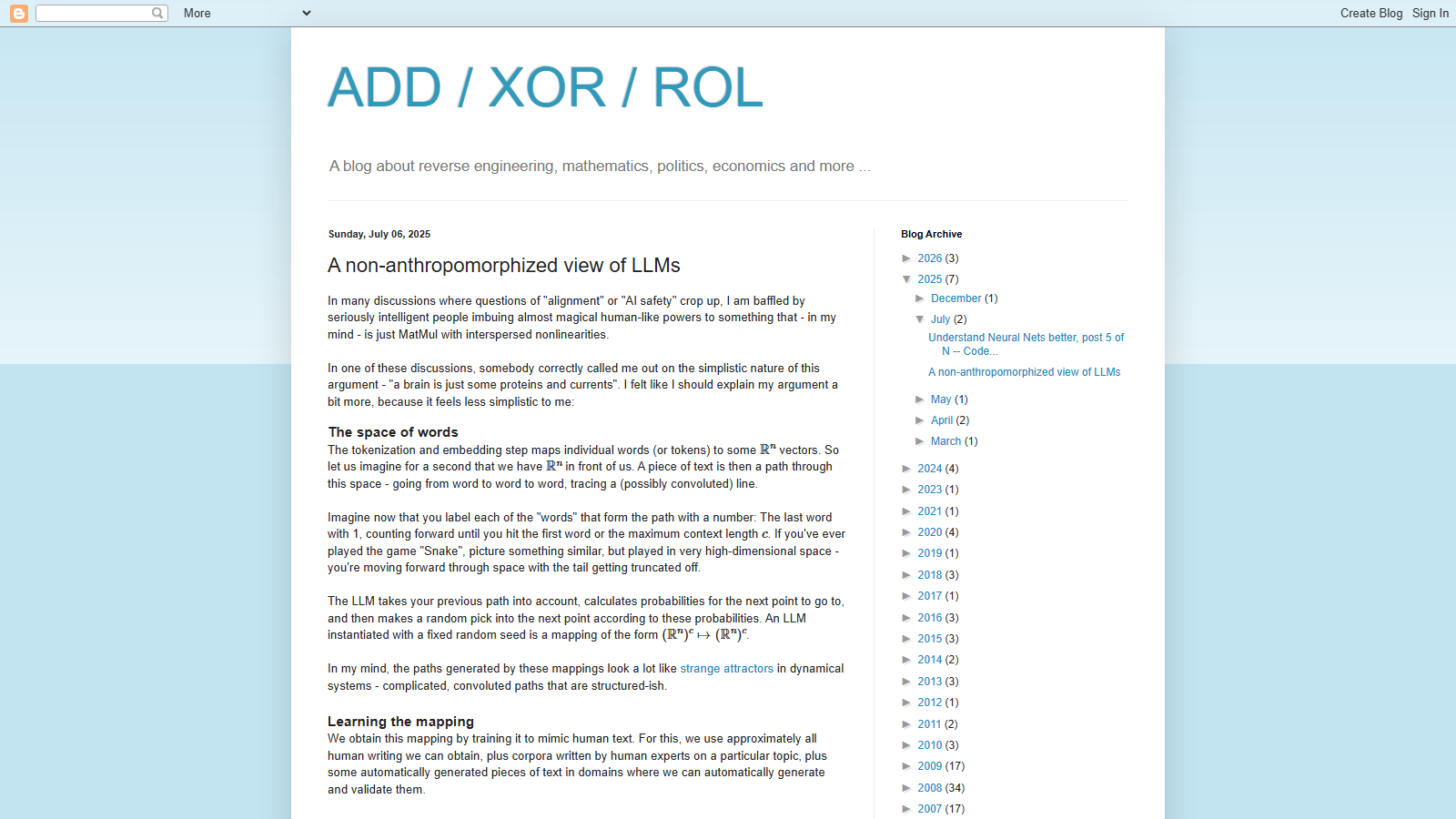
Blogger page headed ADD / XOR / ROL with the post 'A non-anthropomorphized view of LLMs', dated Sunday July 06 2025, showing the sections 'The space of words' and 'Learning the mapping' beside a blog archive sidebar

AI and Developer Psychology

A Non-Anthropomorphized View of LLMs by Halvar Flake

llm ai safety anthropomorphism embeddings

Halvar Flake (Thomas Dullien), a reverse engineer and security researcher, uses his blog ADD / XOR / ROL to make a narrow, technical case against how AI safety discussions talk about language models. His starting complaint: serious people discuss "alignment" as though a piece of software might develop something like a will of its own.

The post builds its argument from the mechanics. Tokens map to vectors in a high-dimensional space, and a piece of text becomes a path through it, one word at a time, out to the model's context length. A trained model with a fixed seed is, in his framing, a mapping that takes one such path and returns the next point on it, nothing more mysterious than that. He extends the same lens to "alignment," recasting it as the unsolved, largely mathematical problem of bounding how often an undesirable sequence gets generated, rather than a question about a model's values or intentions.

He is upfront that the piece is opinionated rather than empirical: no data, no experiment, just an argument laid out paragraph by paragraph, including his guess at why researchers who believe they might be building something mind-like resist this framing. He closes by comparing LLMs' likely real-world impact to electrification rather than to anything resembling a new kind of being.
02
seangoedecke.com
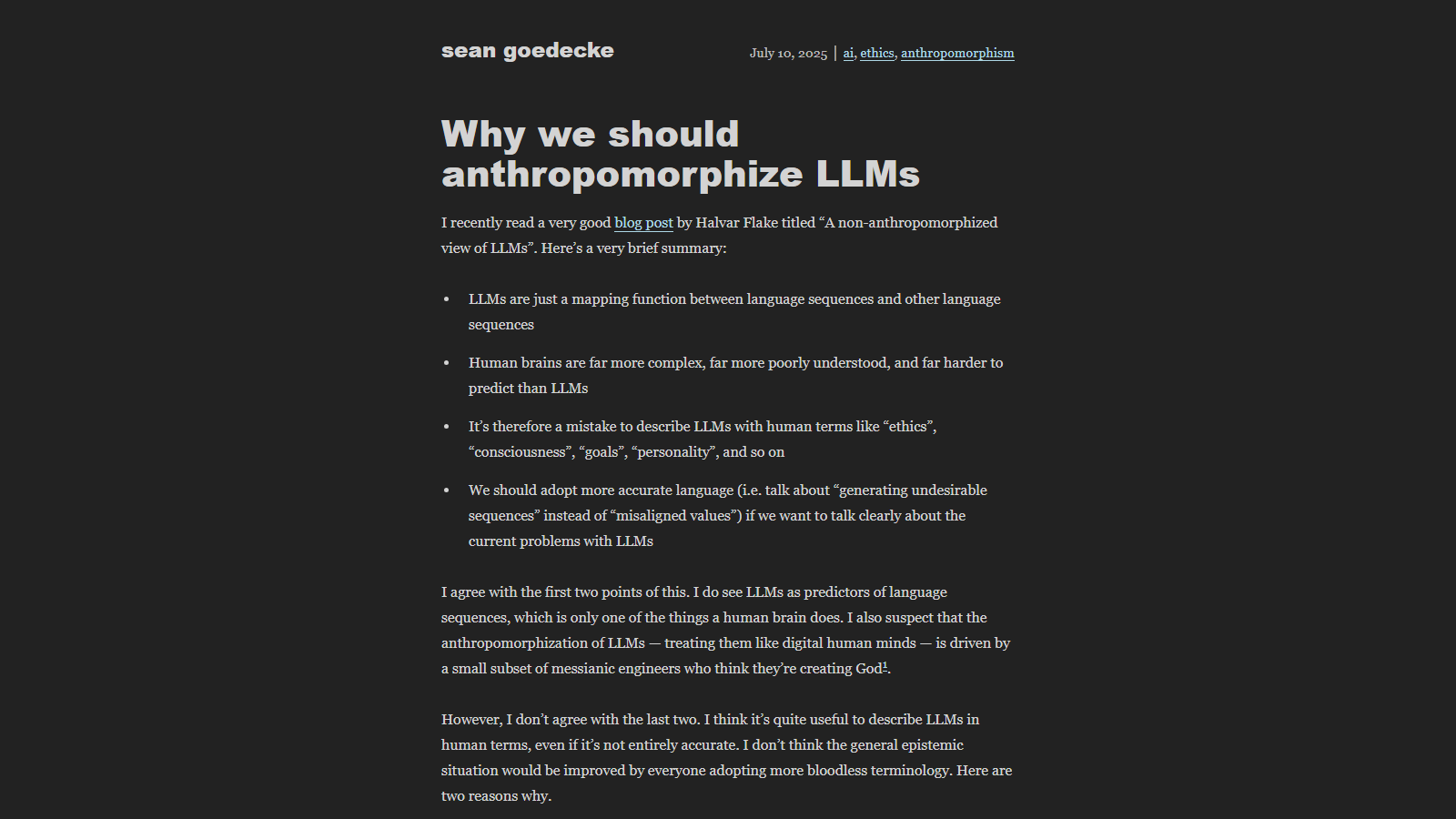
Dark-themed blog post "Why we should anthropomorphize LLMs" by sean goedecke, dated July 10 2025 and tagged ai, ethics, anthropomorphism, opening with a bulleted summary of Halvar Flake's argument

AI and Developer Psychology

Sean Goedecke Makes the Case for Anthropomorphizing LLMs

llm anthropomorphism ai ethics

Sean Goedecke's blog offers a working engineer's take on how to talk about large language models, arguing that describing them in human terms is genuinely useful rather than just a sloppy habit.

The post is written as a direct reply to Halvar Flake's essay arguing for strictly technical, non-anthropomorphized language about LLMs. Goedecke agrees that LLMs are, mechanically, sequence predictors far simpler than human brains, but pushes back on the conclusion that human vocabulary should therefore be dropped. His first argument: assistant models like ChatGPT are deliberately post-trained to have a personality, so words like "obsequious" describe a real, intentional design choice rather than a category error. His second is a moral-caution argument, drawing on historical cases where humans wrongly denied inner experience to animals and to other humans, concluding that defaulting toward the more generous, human-flavored language is safer than defaulting toward the more dismissive, technical kind.

The piece is short, opinionated, and reads best after, or alongside, the essay it responds to, since Goedecke assumes the reader already knows roughly what non-anthropomorphized language sounds like. It is a clear entry point for anyone working through how casually to talk about model behavior, though it argues from analogy and intuition rather than from empirical evidence either way.

03
lesswrong.com
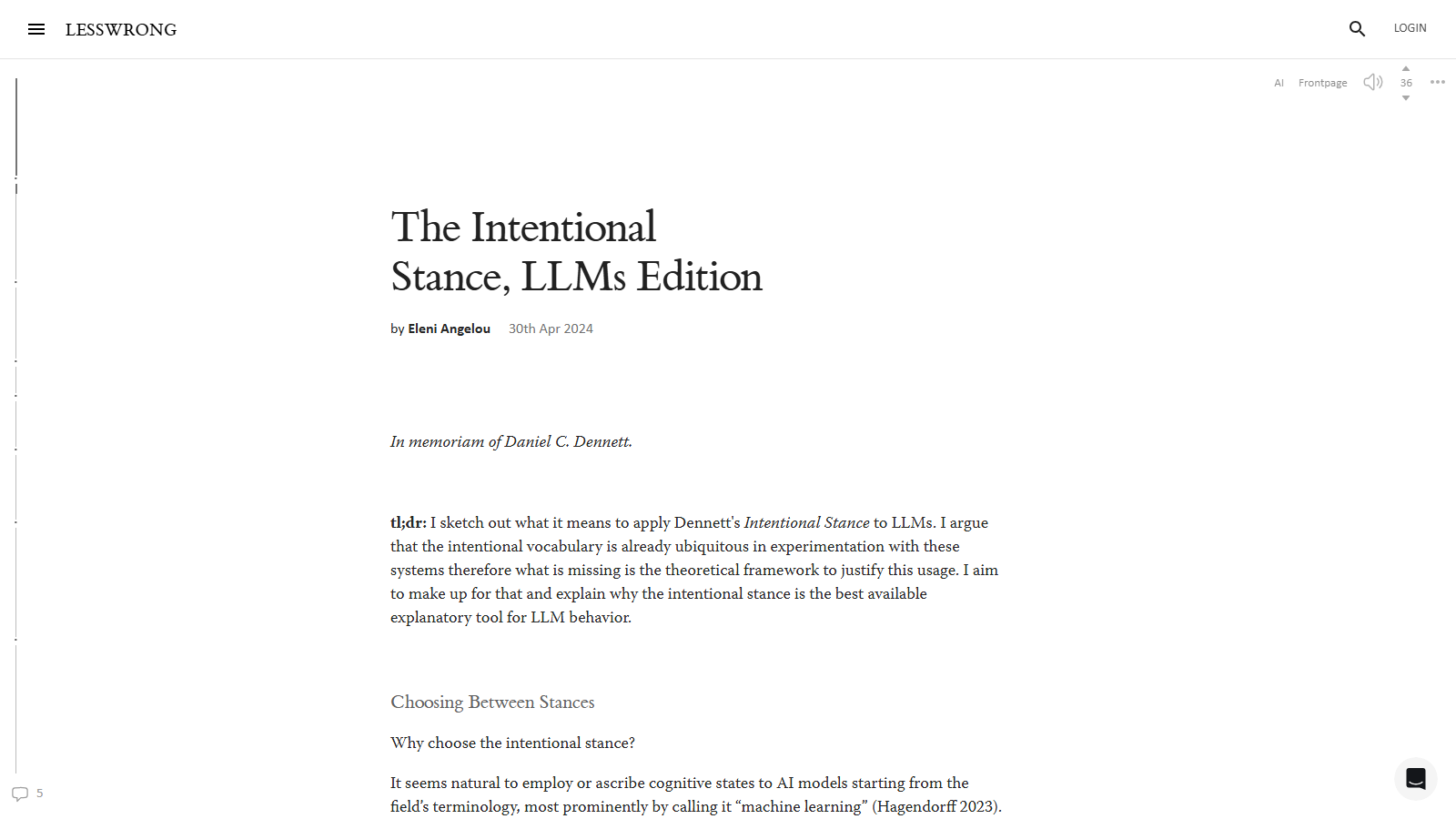
Screenshot of the LessWrong post "The Intentional Stance, LLMs Edition" by Eleni Angelou, dated 30 April 2024 and dedicated to Daniel C. Dennett, showing the tl;dr summary and the section heading "Choosing Between Stances"

AI and Developer Psychology

Dennett's Intentional Stance Applied to LLMs on LessWrong

ai agency daniel dennett intentional stance philosophy of ai

LessWrong is a community blog for people who want to reason carefully about minds, human and artificial alike, and this post by Eleni Angelou earns a spot in the catalog by testing philosopher Daniel Dennett's framework directly against how large language models behave.

The piece walks through why Dennett's intentional stance — treating a system as if it has beliefs, desires, and goals, whenever that lens predicts its behavior better than tracing its code or hardware does — fits LLMs better than the alternatives. Angelou points to concrete evidence: models scoring at or above human level on tasks like bar exams and reasoning benchmarks, and outputs that are, in practice, hard to tell apart from a person's. She borrows Dennett's own comparison to intelligent aliens, arguing that once a system's behavior gets sophisticated enough, treating it as if it has a mind becomes the most useful predictive strategy, not a claim about what is actually happening inside it.

The argument stays pragmatic rather than metaphysical: Angelou proposes a strategy for prediction and explanation, not a claim that LLMs literally hold beliefs or want things. The post is candid about its limits, too — commenters push back with cases like hallucinations, where treating the model as an intentional agent stops predicting what it actually does. Anyone curious how philosophy of mind maps onto today's AI systems, with no computer science background required, will find this a readable entry point, though it stays at the level of argument rather than technical implementation.

04
aethermug.com
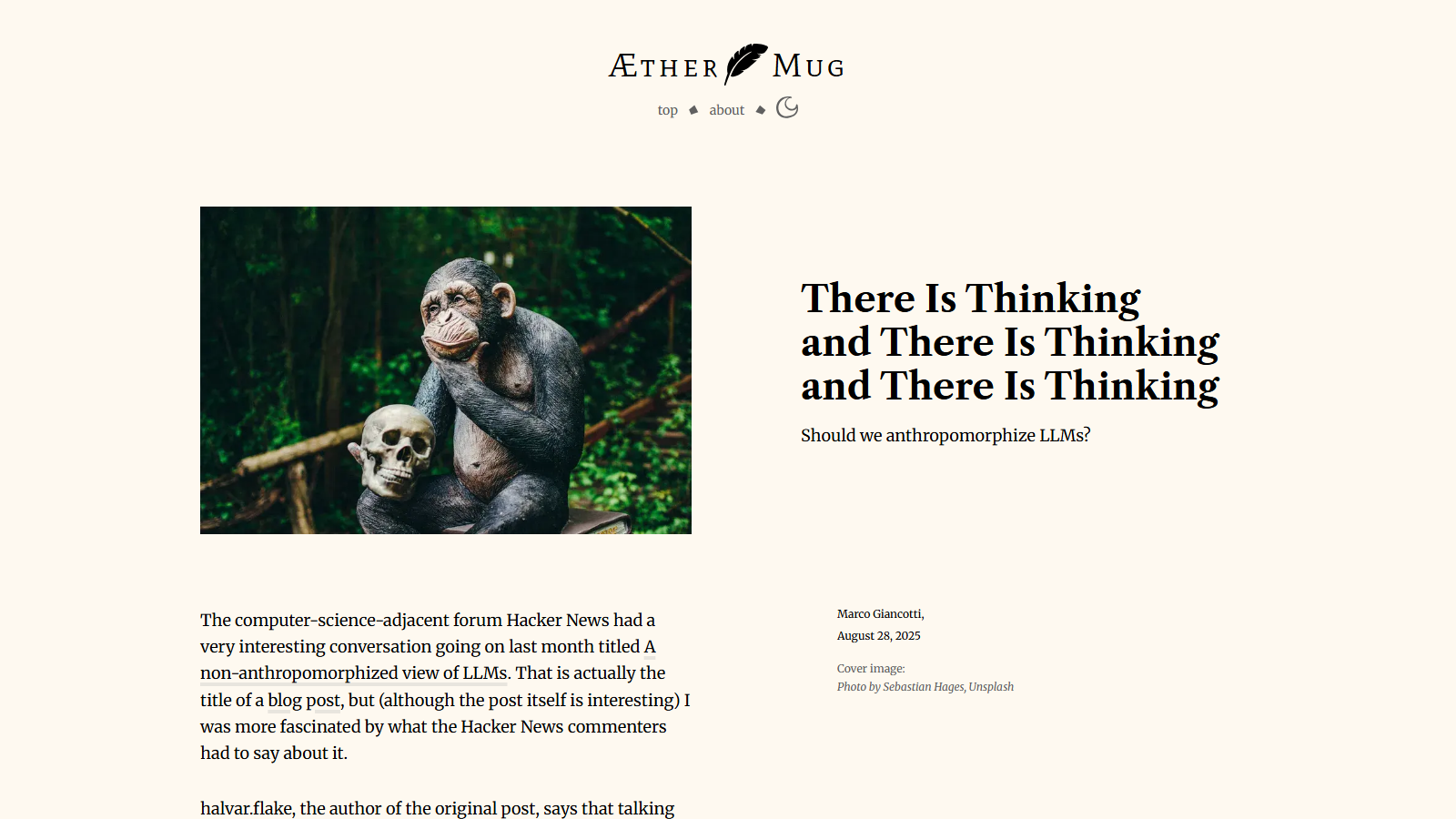
A carved wooden statue of a chimpanzee resting its chin on its hand while holding a human skull, set against a forest backdrop, above the Aether Mug post titled There Is Thinking and There Is Thinking and There Is Thinking by Marco Giancotti.

AI and Developer Psychology

Why 'Thinking' Needs Sorting Out Before We Argue About LLMs

llm anthropomorphism philosophy of mind thinking

Aether Mug, the personal blog of writer and programmer Marco Giancotti, is where this piece works through a question the AI world keeps arguing past each other on: what does it actually mean to say a language model "thinks"?

Responding to Halvar Flake's essay arguing that large language models are best described as mathematical functions rather than agents that "behave" or "decide," Giancotti steps back from that specific dispute and asks a broader one: whether the word "thinking" even has one stable meaning worth arguing about. He draws a parallel to a century-old fight inside biology, where scientists have long debated whether it is acceptable to describe evolution in purpose-driven language, even though nothing about natural selection intends anything. Darwin himself worried about this exact wording problem, and more recent primatologists have settled on using human-like terms carefully and testably rather than assuming they map cleanly onto animal minds.

Giancotti applies that same caution to language models: calling their output "prediction" in one sentence and "intelligence" in the next is inconsistent, and neither label is obviously the correct one. He does not resolve the argument, and says so directly. What makes the piece worth reading is not a verdict but the reframing — "does it think" becomes a question about which abstraction level is doing useful work, not a yes-or-no fact waiting to be discovered, and that distinction is the actual subject of the essay.

05
link.springer.com
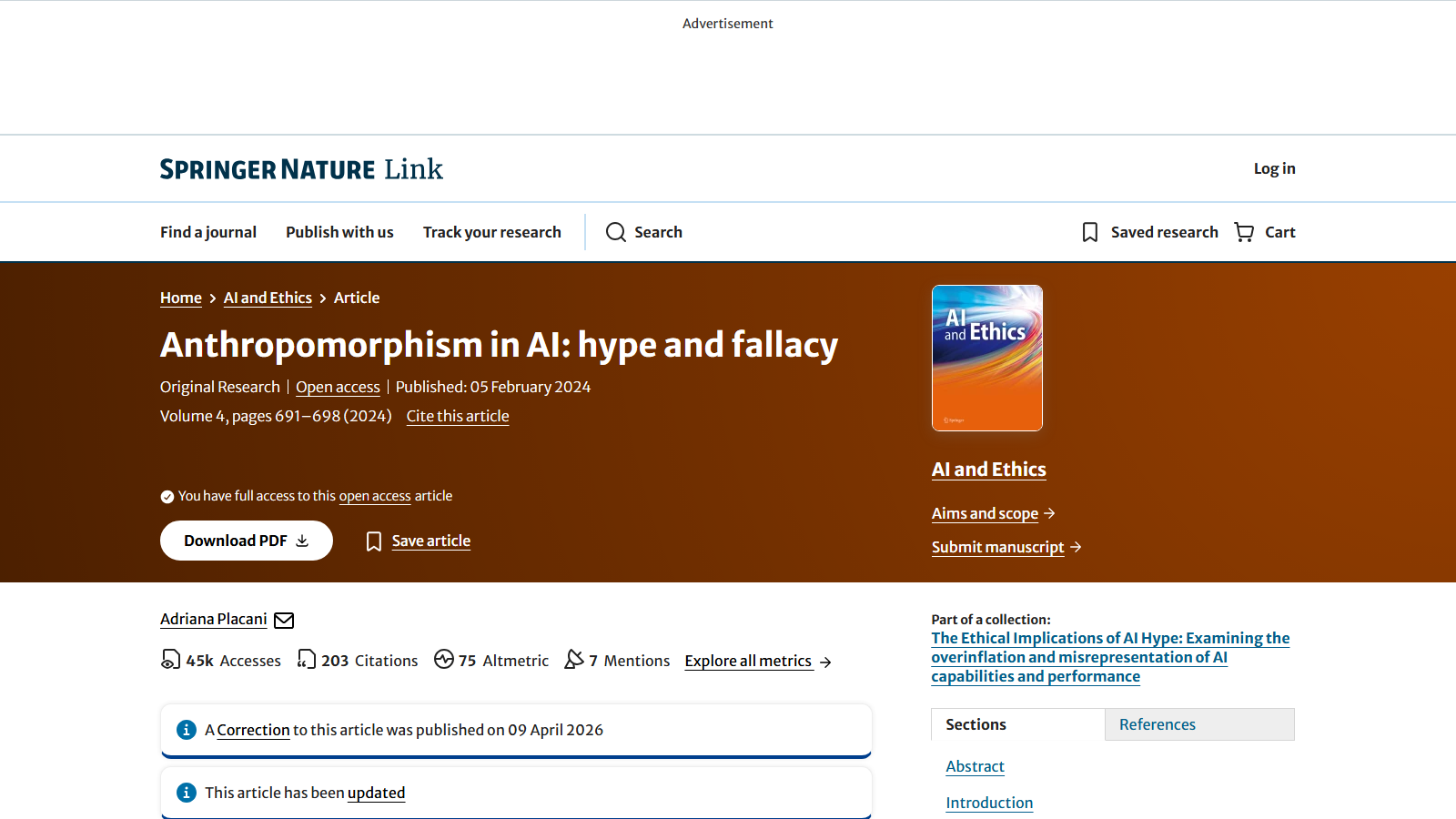
Springer Nature Link article page for 'Anthropomorphism in AI: hype and fallacy' in the journal AI and Ethics, marked Original Research and Open access, published 05 February 2024, by Adriana Placani, showing a correction notice, a Download PDF button, and the journal cover.

AI and Developer Psychology

A Philosopher's Case Against Anthropomorphizing AI Systems

research anthropomorphism ai ethics ai hype

AI and Ethics, an open-access philosophy journal, published this paper by Adriana Placani, a philosopher at Nova University of Lisbon's Institute of Philosophy, making the case against talking about AI systems as if they were people.

Placani treats anthropomorphism as two separate problems. As hype, it inflates what AI can actually do: she traces the pattern from Alan Turing describing a machine doing "homework," through a robot's own creator calling it "basically alive" on television, to a tech executive musing that large neural networks might be "slightly conscious." As a fallacy, it distorts moral reasoning about AI - judgments about its character, its moral status, who is responsible for its actions, and whether it can be trusted - because those judgments quietly assume AI has intentions and feelings it does not have.

The argument is philosophical rather than technical: there are no benchmarks or experiments here, just a close reading of how ordinary language about AI, systems that "learn," assistants that are "listening," shapes belief even in readers who think they are being critical. It suits anyone who wants the conceptual case for why "the chatbot seems to care" is a claim worth questioning, more than it suits someone looking for a practical how-to guide.

End of trail

← All trails