AI and Developer Psychology
In Defense of Stochastic Parrots: How LLMs Predict Text
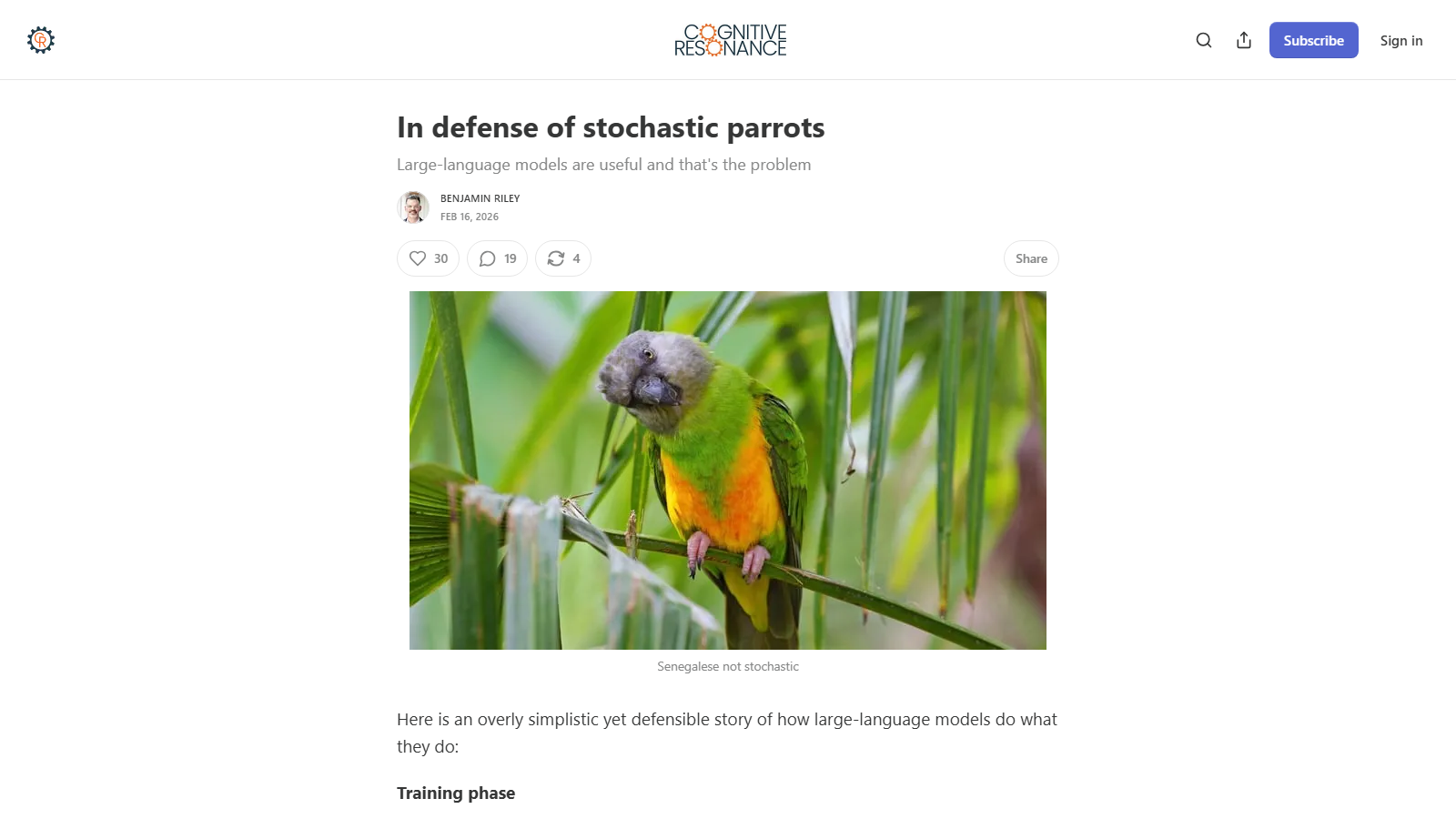
Benjamin Riley runs Cognitive Resonance, a newsletter and consultancy built around explaining how AI systems actually work to schools and educators, so it's worth saying upfront: steering people toward caution about casual AI use is also the case his consulting practice is built to make.
The essay itself is a plain mechanical explanation of what a large language model does. During training, the model is fed text with pieces hidden, guesses what's missing, and adjusts its internal weights based on how close the guess was, repeated across enormous volumes of writing. At inference time, the model isn't retrieving facts or reasoning toward a conclusion — it's producing a statistical guess about what text should come next, and Riley is careful to note that "what should come next" has no single objective answer.
That's the basis for his defense of the term "stochastic parrot": stochastic describes the guessing process accurately, and parrot captures that the output is pattern-matched language rather than understood meaning. Riley treats this as a neutral, technically accurate description rather than an insult, and argues that the same usefulness that makes these models valuable is exactly what makes them worth worrying about.
He closes by turning to education specifically, arguing students reach for these tools to skip the cognitive effort that learning actually requires — a narrower, more opinionated point than the mechanistic argument that carries the rest of the piece.