AI datacenters
AI Data Center Siting and Regional Power-Grid Stress, on arXiv
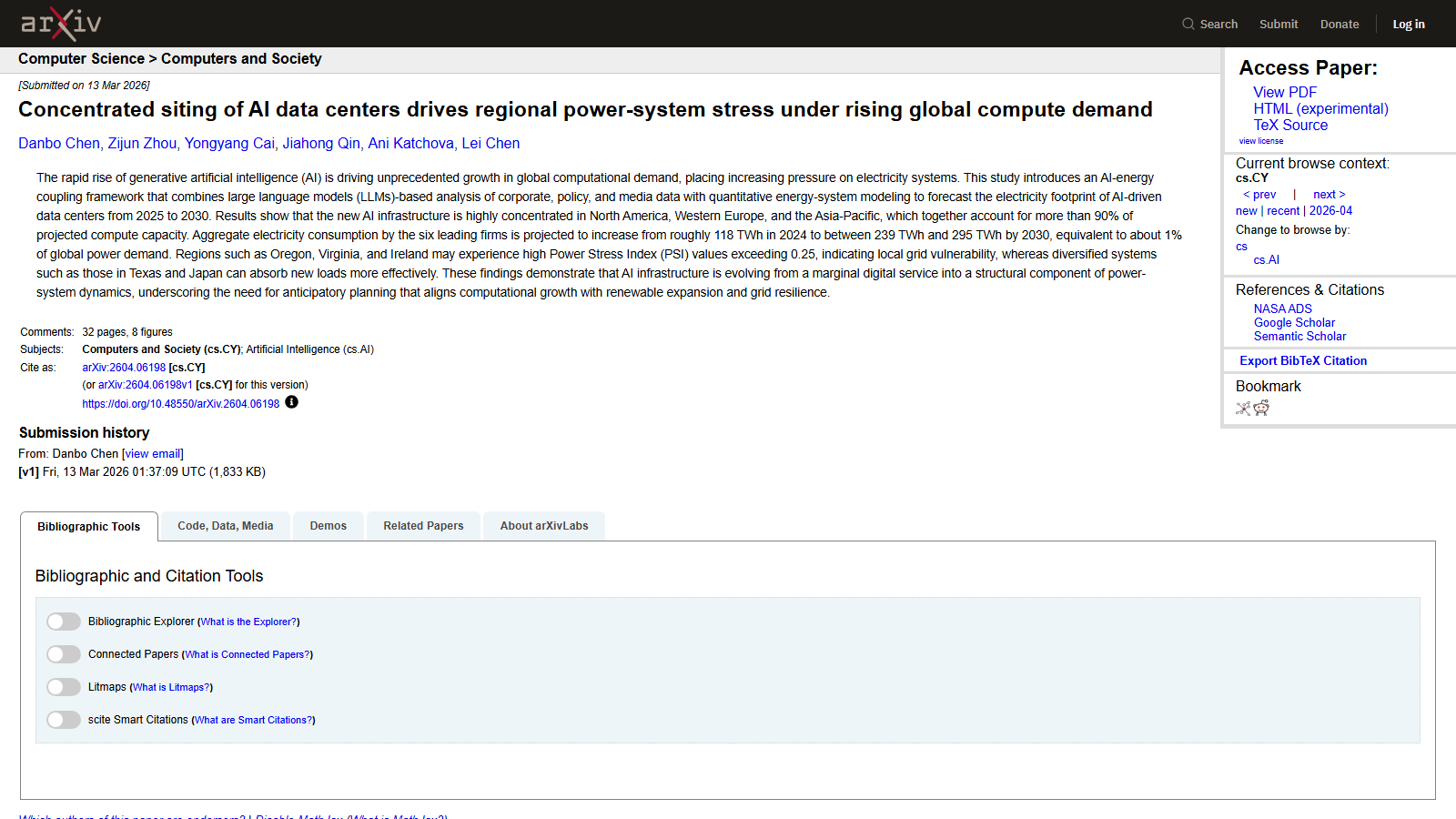
arXiv hosts this preprint, an AI-energy coupling framework that models where AI data centers are being built and what that concentration does to the power grids beneath them. It earns catalog space for pairing corporate, policy and media data with quantitative energy-system modeling rather than repeating a single company's roadmap.
The paper's numbers run from 2025 to 2030, and it presents them as projections, not measurements. North America, Western Europe and the Asia-Pacific are modeled to hold more than 90% of new AI compute capacity, and the six leading firms' aggregate electricity use is projected to climb from roughly 118 terawatt-hours in 2024 to somewhere between 239 and 295 terawatt-hours by 2030, about 1% of global power demand. Those figures come out of a forecasting model, not a count, so treat the range as stated uncertainty rather than a settled outcome.
The more specific finding is regional. The authors define their own Power Stress Index to flag where new data-center load meets a less accommodating grid, and by that measure Oregon, Virginia and Ireland score above 0.25, while Texas and Japan absorb comparable new load more easily. The index is the paper's own construction, not an established grid-reliability standard, so its ranking is only as sound as its inputs.
The honest trade-off: this is an arXiv preprint that has not been through peer review, and the abstract page gives you the headline figures while 32 pages of methodology and 8 figures sit behind the PDF link.