AI datacenters
Cradle-to-Grave Emissions Study of Google's TPU Hardware
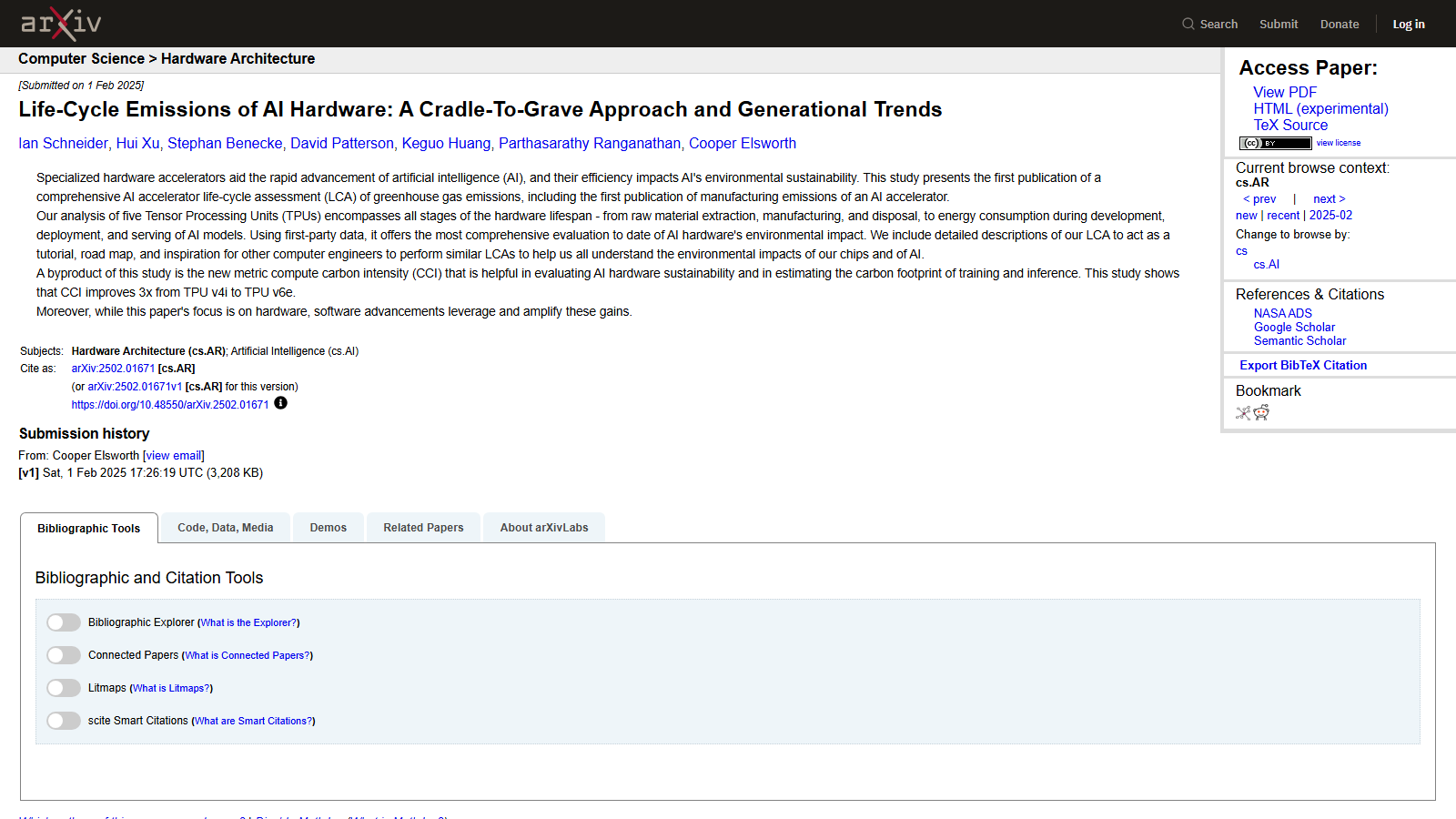
This arXiv preprint presents what its authors call the first published cradle-to-grave life-cycle assessment of greenhouse gas emissions for an AI accelerator, covering five generations of Tensor Processing Units. It has not been through peer review. The seven authors, including well-known hardware researchers David Patterson and Parthasarathy Ranganathan, work at Google and are assessing Google's own TPU hardware using first-party manufacturing data. That dual role is exactly what makes numbers like these available at all, since chip manufacturing emissions are rarely disclosed by the companies that build the hardware, and it is also a conflict of interest worth weighing alongside the results.
The paper tracks emissions from raw material extraction and manufacturing through disposal, deliberately leaving aside the energy and water a chip draws once it is running in a datacenter. It introduces a "compute carbon intensity" metric meant to let engineers compare hardware generations on manufacturing footprint alone, and reports that this metric improves threefold between the TPU v4i and TPU v6e generations.
The appeal here is methodological transparency: the authors describe their life-cycle assessment process in enough detail to work as a rough template for engineers wanting to run a similar study on other hardware. It is a narrow slice of AI's environmental footprint, manufacturing and disposal only, drawn from a single vendor's internal figures, so treat it as one detailed data point rather than an industry-wide benchmark.