AI and Developer Psychology
Biometrics of AI-Assisted Coding Workload, on arXiv
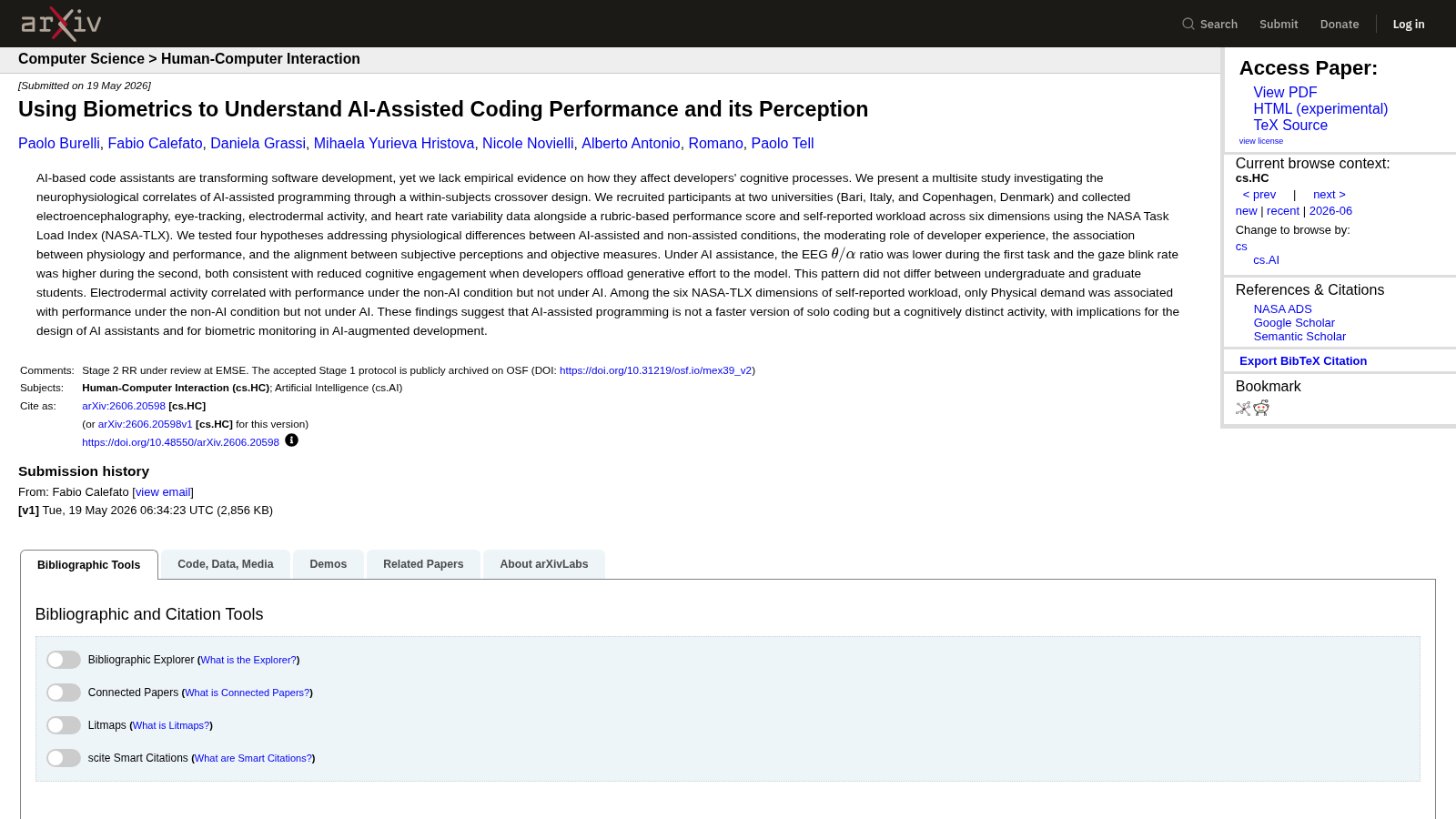
arXiv hosts the preprint of a multisite study that wires developers up to sensors while they code with and without an AI assistant, and it earns catalog space because it measures what most AI-coding claims only assert.
You get the whole design on the abstract page, not a summary of it. Researchers at universities in Bari, Italy and Copenhagen, Denmark ran a within-subjects crossover study, recording electroencephalography, eye-tracking, electrodermal activity and heart-rate variability alongside a rubric-based performance score and self-reported workload across the six NASA Task Load Index dimensions. Under AI assistance the EEG theta/alpha ratio was lower on the first task and the gaze blink rate higher on the second — both, the authors write, consistent with reduced cognitive engagement when generative effort is offloaded to the model. Those are correlates, not evidence that anyone thought less, and the pattern did not differ between undergraduate and graduate students.
The conclusion is the part worth carrying into your own arguments: AI-assisted programming looks like a cognitively distinct activity, not a faster version of solo coding.
The honest limit is its status. The comments line marks it a Stage 2 registered report still under review at Empirical Software Engineering, with the Stage 1 protocol archived on OSF. The design was reviewed before any data was collected, which is more than most studies here can say, but the findings themselves have not finished peer review.